Data flow measuring bridge
To determine a bridge ratio from the bridge voltage UBridge and the measured supply voltage USense, the two corresponding measured voltage values of the analog inputs are offset against each other in a virtual channel in the device. The ratio of UBridge Ch. 1 to USense Ch. 1 then gives the result that can be read out in RMB Ch. 1. The signal acquisition and data processing of the virtual channel of this device is as follows:
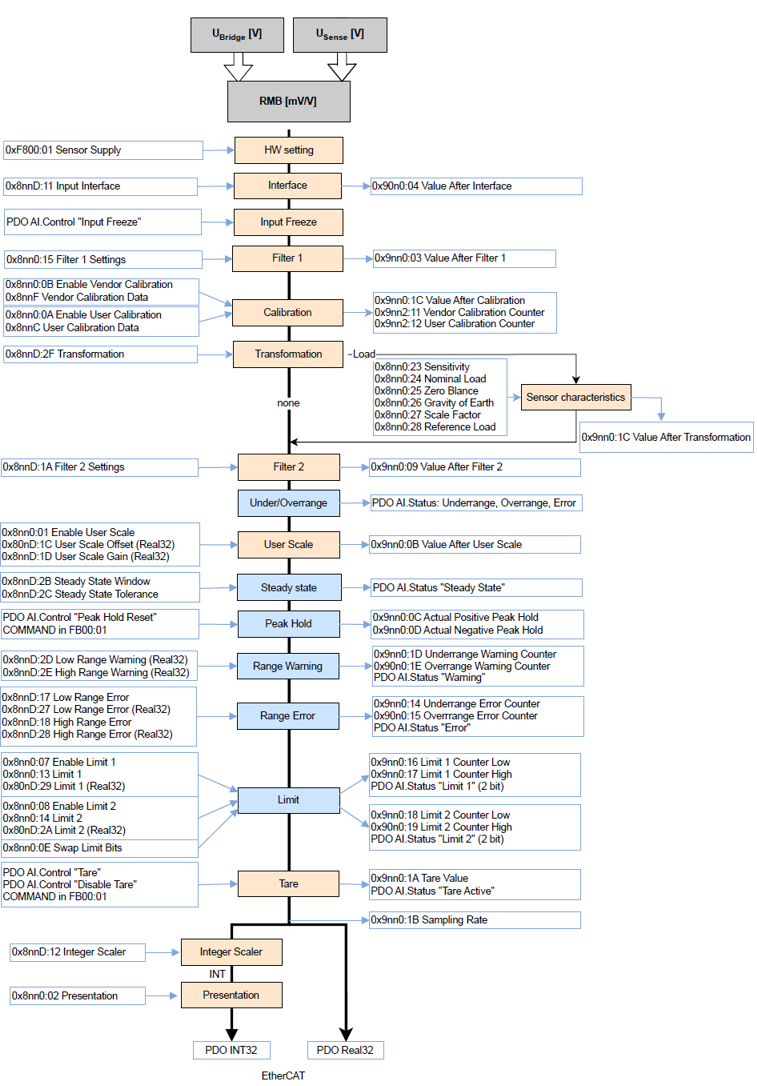 Fig.48: Data flow measuring bridge
Data flow diagram legend | ||
Left column: | Middle column: | Right column: |
This terminal only uses floating point calculations internally, as shown in the data flow. This considerably simplifies and shortens the commissioning of the analog channel, which minimizes errors in understanding. In addition, intermediate values along the data calculation can be easily displayed in the CoE.
The Real32 and INT16 values are defined in the CoE without units. However, the unit is determined by the context and should, wherever possible, be regarded as an SI unit. For example, the voltage is measured in V, the current in A (even with 20 mA input!), the resistance in ohms and the ratio in V/V....
Note: Individual functional units (see data flow) have already been introduced in earlier analog devices based on INT16 (integer) and are controlled by these INT-based parameters. Such INT parameters are still supported for compatibility reasons. For example, existing code in the controller should access the CoE via ADS. This means that parameters of functional units are either
- only available as REAL32 types in the CoE if the functional unit was newly introduced with the FloatingPoint data flow, or
- are present in the CoE both as INT type and as REAL32 type with the same meaning, recognizable by the name suffix "(Real32)". The values are automatically mirrored by the firmware when they are changed or taken into account one after the other.
When re-implementing the analog function, it is recommended to use the Real32 parameters.
Commissioning of the analog input in TwinCAT should follow this data flow and is described below.