FB_BA_DynamicArray
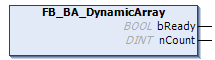
The function block generates and deletes memory areas dynamically so that entries can be added and removed at runtime.
As soon as the maximum capacity of the array is reached, the internal memory area is automatically extended. If the capacity significantly exceeds actual demand, the internal memory area is reduced accordingly.
 | The internally used memory is allocated from the router memory pool and is generated via _NEW and released via _DELETE at runtime. With each adaptation (i.e., extension or reduction in size) of the internal memory, the pointers to the obsolete/adapted memory are also invalid! |
| The data type of the entries is not important for the dynamic array! The user must ensure in every case that the data type is always correctly observed by the application when dealing with contained entries. Furthermore, all data added to the array must have a uniformly defined size! |
It is recommended to use the dynamic array in particular in cases where the expected memory utilization can be estimated relatively well. Router memory is only available to a limited extent (especially with small controllers) and is to be used as efficiently as possible! If necessary, the amount of router memory available in the target system must additionally be adapted.
Syntax:
VAR_OUTPUT
bReady : BOOL;
nCount : DINT;
END_VAR
VAR
nEntrySize : UINT := 0;
nMinExpCount: : UINT := 1;
END_VAR Outputs
Name | Type | Description |
|---|---|---|
bReady | BOOL | State of the allocated memory. (TRUE if at least one entry is contained in the array and memory is thus already generated). |
nCount | DINT | Current number of entries contained. |
Variables
Name | Type | Description |
|---|---|---|
nEntrySize | UINT | Expected size of entries. Used to allocate internal memory and to manage memory areas of recorded entries. |
nMinExpCount | UINT | Size by which the internal memory is to be expanded when the maximum capacity is reached (specified as the number of entries). For further information, see examples of initialization during variable declaration. |
Application
Two typical use cases are imaginable:
Case 1) Array contains data sets
In this case the array contains data sets (generic types such as BOOL, INT, STRING, or structures) by reserving internal memory in accordance with the size of the type used.
Case 2) Array contains pointers
In this case the array contains pointers to externally declared data and only memory corresponding to the size of memory addresses is reserved.
| Instances of the dynamic array are not called cyclically. It is sufficient to use the management functions and properties described here. |
Examples
Example 1:
Data sets of the data type ST_DATA are stored in an array.
Access to the respective data sets takes place by means of pointers to the internal memory of the array or by means of a copy of a data set.
VAR
     fbArray : FB_BA_DynamicArray := (nEntrySize:=SIZEOF(ST_Data), nMinExpCount:=5);
       stMyDataTmp  : ST_Data;
       ptrMyDataTmp : POINTER TO ST_Data;
       nIndexTmp   : DINT;
END_VAR
// 1) Save data in array and remove them with the help of index position:
IF (fbArray.AddEntry(ADR(stMyDataTmp), nResultIndex=>nIndexTmp)) THEN
fbArray.RemoveEntry(nIndexTmp);
END_IF
// 2) List all data sets consecutively:
FOR nIndexTmp = 0 TO fbArray.LastIndex DO
IF (fbArray.GetEntryEx(nIndexTmp, pMemoryPtr=>ptrMyDataTemp)) THEN
ptrMyDataTmp^.diValue := (nIndexTmp+1);
END_IF
END_FOR
// 3) Get a copy of the first data set:
If (fbArray.GetEntry(0, ADR(stMyDataTmp))) THEN
// Edit and update data set:
stMyDataTmp.diValue := 99;
fbArray.SetEntry(0, ADR(stMyDataTmp));
END_IFExample 2:
The addresses of externally declared instances of the function block FB_Object are stored in an array.
VAR

    fbArray : FB_BA_DynamicArray := (uiEntrySize:=SIZEOF(POINTER TO FB_Object), uiMinExpCount:=5);
       fbMyObject1  : FB_Object;
       fbMyObject2  : FB_Object;
       fbObjectTmp  : POINTER TO FB_Object;

       nIndexTmp   : DINT;
END_VAR
// 1) Add object to array and remove it with the help of index position:
If (fbArray.AddEntryPtr(ADR(fbMyObject1), nResultIndex=>nIndexTmp)) THEN
fbArray.RemoveEntry(nIndexTmp);
END_IF
// 2) Add object to array and remove subsequently with the use of the pointer:
fbArray.AddEntryPtr(ADR(fbMyObject1));
fbArray.RemoveEntryExPtr(ADR(fbMyObject1));
// 3) Determine the index position of an object within an array:
IF (fbArray.FindEntryPtr(ADR(fbMyObject1), nResultIndex=>nIndexTemp)) THEN
// Replace entry on position "fbMyObject1" with "fbMyObject2":
fbArray.SetEntryPtr(nIndexTmp, ADR(fbMyObject2));
ELSE
// Error handling
…
END_IF
// 4) Determine first object:
IF (fbArray.GetEntry(0,ADR(fbObjTemp))) THEN
// …
END_IF
// 5) Remove content of the array if it has more than 10 entries:
IF(fbArray.nCount > 10) THEN
fb_Array.Reset();
END_IFError messages
The following error messages may be output in the TwinCAT Output window at runtime:
Error name | Text | Description |
|---|---|---|
[EDB4] | Entry-size of array not defined! | The expected size of entries was not initialized during the declaration of the array. |
[EDB7] | Expansion-count of entries not defined! | The amount by which the internal memory is to be expanded was not initialized when the array was declared. |
 Methods
Name | Definition location | Description |
|---|---|---|
Local | Creates a new data set at the end of the array and copies the content of the specified entry to the internal memory. | |
Local | Determines the position of the specified entry in the array by comparing its content with the data sets of the array. | |
Local | Copies the contents of the data set to a certain position in the specified memory area. | |
Local | Determines a pointer to the internal memory of the specified data set. | |
Local | Removes the data set at the specified index position from the array. | |
Local | Determines the position of the specified entry and deletes it from the array. | |
Local | Resets the complete content of the array. | |
Local | Replaces the existing data set with a new one by overwriting the internal memory area of the existing data set with the value of the new entry. | |
Local | Creates a new entry at the end of the array and copies its memory address (i.e., the address to which the pointer pEntry points) to the internal memory. | |
Local | Determines the position of an entry in the array by comparing its address with the addresses stored in the array. | |
Local | Outputs a pointer to the memory address of the requested entry. | |
Local | Determines the position of the specified entry and deletes it from the array. | |
Local | Replaces an existing entry with a new one. |
 Properties
Name | Type | Access | Definition location | Initial value | Description |
|---|---|---|---|---|---|
CurCapacity | DINT | Get | Local | - | Current capacity of the array (number of entries). Corresponds to the maximum number of entries that can be accepted by the internal memory. |
EntrySize | UINT | Get | Local | nEntrySize | Expected size of entries that are stored in the array. |
LastIndex | DINT | Get | Local | - | Index position of the last entry. This is -1 if no entries exist. |
UsedMemory | UINT | Get | Local | - | Size of the internal memory consumed [bytes]. |