TP
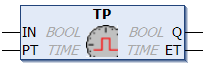
The TP function block, a pulse generator, can be used to generate pulses with a defined pulse duration.
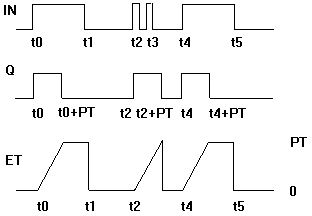
If IN = FALSE and Q = FALSE, the ET output has the value zero. As soon as IN is set to TRUE, Q = TRUE and remains TRUE for the pulse duration PT. As long as Q = TRUE, the time in milliseconds is counted up in ET until the setpoint PT is reached. The Q output remains TRUE until the pulse duration has elapsed, irrespective of the state of the IN input.
Graph showing TP over time:
The TP function block requires 14 bytes of data.
 Inputs
VAR_INPUT
    IN : BOOL; (* Trigger for Start of the Signal *)
    PT : TIME; (* The length of the High-Signal in ms *)
END_VAR
Name | Type | Description |
|---|---|---|
IN | BOOL | Rising edge: Start pulse timer and set Q to TRUE |
PT | TIME | Pulse duration (length of the high signal) |
 Outputs
VAR_OUTPUT
    Q  : BOOL; (* The pulse *)
    ET : TIME; (* The current phase of the High-Signal *)
END_VAR
Name | Type | Description |
|---|---|---|
Q | BOOL | TRUE after a rising edge at the IN input for the pulse duration PT. |
ET | TIME | Elapsed time since the start of the pulse timer. |
Requirements
Development environment | Target platform | PLC library to include |
|---|---|---|
TwinCAT v3.0.0 | PC or CX (x86) | Tc2_Standard |