Connection, display and diagnostics
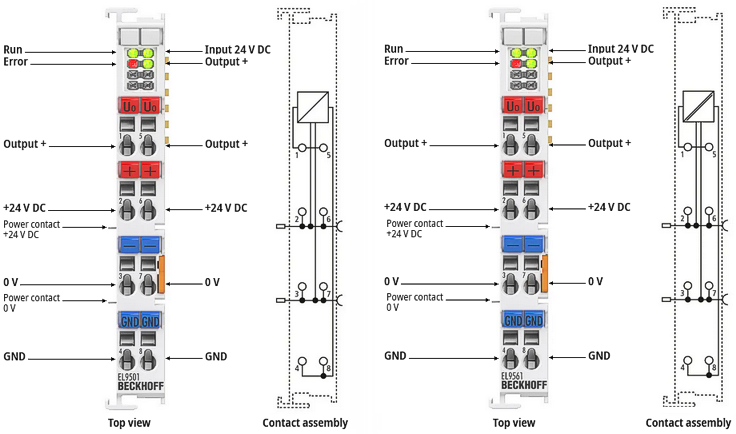
Connection, display and diagnostics 1:Fig.5: EL9501, EL9561 - LED and connection

LED

Color

Meaning

RUN

green

These LEDs indicate the terminal's operating state:

off

State of the EtherCAT State Machine: INIT = initialization of the terminal

flashing

State of the EtherCAT State Machine: PREOP = function for mailbox communication and different default settings set

Single flash

State of the EtherCAT State Machine: SAFEOP = verification of the Sync Manager channels and the distributed clocks.
Outputs remain in safe state

on

State of the EtherCAT State Machine: OP = normal operating state; mailbox and process data communication is possible

flickering

State of the EtherCAT State Machine: BOOTSTRAP = function for Firmware updates of the terminal

Error

red

Error (corresponds to error bits), see Device diagnostic functions

Input

green

24 V input voltage is present.
(switch-on threshold at >19 V, switch-off threshold at <18 V)

Output

green

Output voltage >0.1 V is output.

Notice

Observe the analog manual!

The notes on analog cable layout/routing in the Beckhoff analog manual must be observed!

Notice

Cable lengths >30 m

For cable lengths >30 m, suitable overvoltage protection must be provided (e.g. EL9540-0010) if corresponding interference could affect the signal cable.

Connection EL9501, EL9561

Terminal point

No.

Comment

Internally connected with connection

Max. current carrying capacity *)

EL9501

EL9561

Output+

1

Adjustable output voltage UP,out, positive reference point

5

5

2 A, overload protected

+24 V

2

+24 V input voltage UP,in

positive power contact, 6

positive power contact, 6

10 A

0 V

3

0 V input voltage

negative power contact, 3, 4, 7, 8

negative power contact, 7

10 A

GND

4

Adjustable output voltage UP,out, negative reference point

negative power contact, 3, 4, 7, 8

8

2 A ***)

Output+

5

Adjustable output voltage UP,out, positive reference point

1

1

2 A, overload protected

+24 V

6

+24 V input voltage UP,in

positive power contact, 2

positive power contact, 2

10 A

0 V

7

0 V input voltage

negative power contact, 3, 4, 7, 8

negative power contact, 3

10 A

GND

8

Adjustable output voltage UP,out, negative reference point

negative power contact, 3, 4, 7, 8

4

2 A ***)

*) Constant current; short-term higher currents are to be avoided and can cause thermal overload (damage)

**) The "GND" potential is internally coupled to the "0 V" potential, but is subject to a reduced current carrying capacity

***) With EL9501, 0 V and GND are connected internally with low impedance, the connection can only be loaded up to the specified value

Safety and operating instructions

DANGER

Cascade connection operation,
risk of injury due to electric shock/arcing/burning

Operation of the EL9561 in a serial/cascaded circuit, e.g. to emulate stacked battery cells, is permitted.
Dangerous voltages > low voltage (60 V DC, 48 V AC) can be reached.

WARNING

Connection, display and diagnostics 2:

Risk of injury due to electric shock/arcing/burning

The following instructions (Part I) must be observed:

  • The operator must ensure that this product is only installed and operated in perfect working order and by sufficiently qualified and authorized personnel.
  • Intended use: industrial, stationary indoor use:
    The analog input devices extend the field of application of the Beckhoff Bus Terminal system with functions for measuring sensor signals via voltage, current or resistance. The intended field of application is data acquisition and control tasks in industrial automation. Use of the terminal beyond its intended use is not permitted.
  • The decision to use and release for operation must be made by an electrotechnical specialist in accordance with the applicable safety rules (occupational health and safety) for the application. National regulations may have to be observed.
  • Ensure proper wiring by following all local and national regulations.
  • The cables and plugs used must be in the required measuring category or be approved for the applied voltages. Note: when laying such cables, it may be necessary to comply with installation specifications, such as those specified in EN 60204.
  • Live measuring cables must be equipped with a maximum fuse protection of 1 A close to the source to prevent high energy input into the cable section or the measuring device in the event of a fault.
  • The installation must be thoroughly checked for incorrect wiring before commissioning; appropriate cable labeling/marking is recommended.
  • To protect against direct contact, the terminal must be installed in a control cabinet that complies with protection class IP54 or higher in accordance with EN 60529. The control cabinet must be connected to the system protective earth (PE).
  • Voltages > 60 V DC / 48 V AC should not be supplied when the control cabinet is open. Supplying these voltages is only permitted in individual cases, when safety precautions have been taken by appropriately qualified personnel.
  • If the application contains unearthed potential differences and an earth fault can pose a hazard, an insulation monitor must be provided and evaluated.
  • Check the terminal before, during and after installation and periodically during breaks in operation for visible damage, such as damaged/cracked sockets/cables/plugs and loose parts. If damage is present, commissioning or further operation is prohibited.
  • Ensure that the device and the wiring are de-energized on the field and bus side during installation/assembly/testing/disassembly. The 5 safety rules of electrical engineering must be observed:
    - De-energize
    - Secure against reconnection
    - Ensure that no voltage is present
    - Ground and short-circuit
    - Cover or isolate adjacent live parts
  • Avoid foreign bodies entering the housing.
  • Do not modify or attempt to repair the device.
  • Do not open the terminal or interfere with the interior of the terminal.

WARNING

Connection, display and diagnostics 3:

Risk of injury due to electric shock/arcing/burning

The following instructions (Part II) must be observed:

  • Do not use the terminals in a damp or explosive environment. Check the installation regularly for contamination.
  • The terminal may only be used in areas with a maximum pollution degree of 2 (non‑conductive pollution) in accordance with IEC 60664-1.
  • Do not use the device in damp locations or in areas where moisture or condensation is likely to occur.
  • The ambient conditions regarding temperature, humidity, heat dissipation, EMC and vibrations, as specified in the operating instructions under technical data, must be observed.
  • After final decommissioning or in the event of damage, the terminal must be clearly marked and, if necessary, disposed of in such a way as to prevent hazards from careless use.
  • The terminal does not provide electrical safety (double insulation) in the event of a single fault in accordance with EN 61010. If this requirement exists with regard to danger to people, additional protective measures must be taken on the application side, both on the communication side (EtherCAT) and on the supply side (24 V), see EN 61010-1:2020 chap. 6.5.
  • The terminal has no CAT rating against typical mains transient overvoltage in accordance with EN 61010. Operation of the output with mains reference is not intended (not even only N or GND connection) and is also not possible for Output+ due to its properties as a source.

Notice

Notes on operation General

The following instructions must be observed

  • The terminal mounted on the DIN rail must be covered on the right by either a subsequent terminal or the EL9011 bus end cap.
  • SELV/PELV circuits (Safety Extra Low Voltage) in accordance with IEC 61010-2-201 must be used to supply this device (see note on power supply).