Frequency measurement
In addition to the count value, the frequency value (Frequency value) can also be calculated and displayed. The following limit values apply to the determination of measured values:
Measured value | Measured value limit | Comment | |
|---|---|---|---|
Lower | Top | ||
Frequency value | 0.095 Hz | 5 MHz | With 4-fold evaluation |
0.095 Hz | 1 MHz | With 4-fold evaluation | |
0.095 Hz | 100 kHz | With 4-fold evaluation | |
Frequency measurement procedure (Frequency value)
The frequency is calculated from the number of increments or position value changes within a time interval. The result is output via the process data “Frequency value” (0x60n0:13).
Frequency = number of periods / time interval | |
|---|---|
Number of periods | The number of complete periods on track A within the timeframe (0x80n0:11) is measured. Counting starts with the first positive edge within the timeframe (index 0x80n0:11 “Frequency window”). |
Time interval | The time measurement starts with the first positive edge on track A within the “Frequency window” and ends with the last negative edge within the “Frequency window”. The time is measured with a resolution of 10 ns. Special case: |
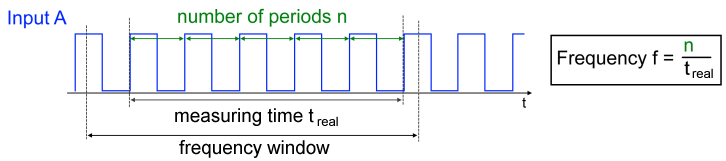
- The frequency window is selected in index 0x80n0:11 “Frequency window”. The default value is 10 ms.
Follow the instructions below to select the correct timeframe. - “Frequency scaling” (index 0x80n0:13) indicates the resolution of the output frequency. The default value is 0.01 Hz. The frequency can also be output in the unit 1 Hz (set 0x80n0:13 “Frequency scaling” to 1dec). If other resolutions are required, the conversion can be done via 0x80n0:1D “Frequency numerator”.
- The calculated frequency value is output via the input process data “Frequency value” (0x60n0:13).
- The calculation is carried out acyclically and without reference to the distributed clock system and is therefore independent of the operation mode.
- Locking the counter value via the gate, a C-reset or external reset has no effect on the frequency calculation.
Correct selection of the timeframe:
In delivery state the timeframe for the frequency measurement is set to 10 ms.
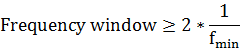
The accuracy and size of the determined frequency depends on the size of the timeframe (0x80n0:11 “Frequency window”), which must be selected to match the application. The minimum value to be entered here is twice the period value of the smallest measured frequency.
At constant velocities, select a larger timeframe so that the best possible averaging can take place.
In situations where frequent positive or negative accelerations are encountered, select a smaller timeframe in order to be able to respond more quickly to changing position values. Alternatively, period value measurement can be used for situations with variable speeds.
Special case: frequency measurement
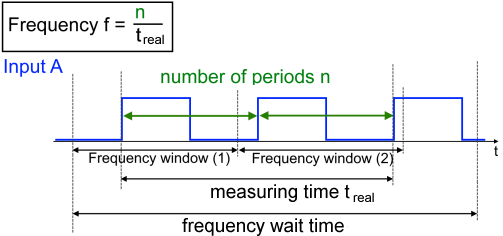
If no full period is detected within the “Frequency window” (see figure (1) below), another “Frequency window” timeframe is started in order to record at least one full period (see figure (2) below). This happens until the maximum waiting time (0x80n0:17 “Frequency wait time”) has elapsed. Until then, the last valid value in the input process data “Frequency value” (0x60n0:13) is displayed.
If no full period is detected within the waiting time, the measurement is discarded and the output in the process data “Frequency value” (0x60n0:13) is set to “0”.
 | Difference between frequency and period value measurement The period value is recalculated for each cycle and output in the process data. The frequency measurement always averages the measured periods over a timeframe. Thus, “Period value” is a current value, and “Frequency value” is an average value. |