Connection example – DC link network (60...170 A devices)
This connection technology enables you to establish a DC link network for servo drives from the AX5160…AX5193 series.
The following figure describes a possible configuration example of a DC link network:
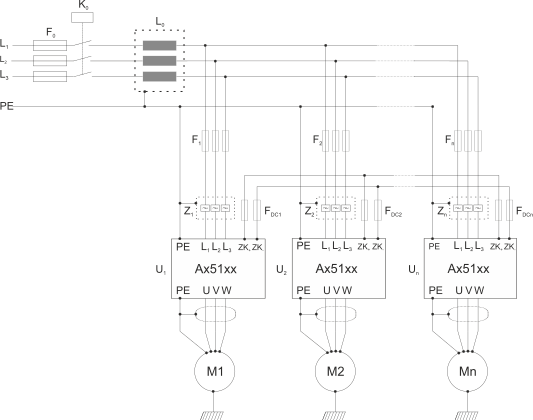
Legend:
F0-n | = | Mains fuses = UL fuse (480 VAC) |
FDC1-DCn | = | DC link fuses (DC fuses) = UL fuse (700 VAC / 800 VDC) |
K0 | = | Common mains contactor |
L0 | = | Mains choke |
Z1-n | = | Mains filter |
NOTICE | ||
 | Configuration of a DC link network! Before implementing a DC link network, please contact your UL certification body and discuss the other necessary boundary conditions. | |
Dimensioning of the UL fuse FDC1-FDCn
The dimensioning of the fuses FDC1 to FDCn in the DC link is application-dependent. The motor and the load profile are incorporated directly into the calculation. Please consider this when dimensioning.
NOTICE | ||
| Fuse holders with UL approval Note when using UL circuit breakers that the necessary fuse holders also have to carry UL approval. | |
Mains choke
To ensure balancing of all servo drives, a common mains choke (Lo) must be provided. The rated current of the mains choke must be ≥ the rated current of the common mains fuse (F0) of the drive system (see chapter Mains fuse). The short-circuit voltage of the mains chokes must be
Uk = 2%.
Dimensioning the mains fuse
The following chapter describes the dimensioning of the mains fuses to be used for individual devices and the use of mains fuses in the DC link network.
Series AX5160…AX5193 (60 A…170 A):
Individual device:
- The mains fuse must be dimensioned such that it corresponds to the rated current of the servo drive multiplied by the correction factor 1.1. The value determined is rounded up to the next larger standard step (see chapter Electrical Data). If the size of the current (in your application) on the mains side is known, the mains fuse can also be dimensioned smaller in accordance.
- The cross-section of the mains supply cable must be dimensioned such that the permissible current carrying capacity of the cable is ≥ the rated current of the selected mains fuse (see chapter Motors and Cables).
DC link network:
- The common mains fuse (F0) must be dimensioned such that it corresponds to the sum of all the rated currents of the servo drives multiplied by the correction factor 1.1. The value determined is rounded up to the next larger standard step (see Dimensioning example). If the size of the current (in your application) on the mains side is known, the mains fuse (F0) can also be dimensioned smaller in accordance.
- The cross-section of the mains supply cable must be dimensioned such that the permissible current carrying capacity of the cable is ≥ the rated current of the selected mains fuse.
- The cross-section of the mains supply cable and the mains fuses (F1 – Fn) of the individual servo drives in the DC link network are to be selected analogously to the operation of the individual servo drives (see chapter „Individual devices”).
The local regulations and the local conditions (ambient temperature, cable routing, etc.) must be referred to when determining the permissible current carrying capacity of the cables (selection of the necessary cross-section – see chapter Motors and Cables).
Dimensioning example:
1 x AX5172 | + | 2 x AX5192 | + | 1 x AX5193 |
|
|
72 A | + | 286 A | + | 170 A | = 528 A x 1.1 = 581 A | 630 A selected |
Mains switch-on conditions:
The mains must be switched through to all servo drives simultaneously. Therefore, use a common mains contactor (K0) for all servo drives. The phase error detection (grid monitoring) of the servo drives must be active. Observe the relevant parameterization for this (P-0-0204 Disable Umain monitoring and Umain phase error detection).
Parameterization P-0-0204:
The default values of the parameter P-0-0204 (Power management control word) are set to:
- Disable Umain monitoring = 0 and
- Umain phase error detection = 1.
In the DC link network the default values of the parameter P-0-0204 are to be checked before commissioning and set to the above values if discrepancies are found.
Parameterization P-0-0214:
To parameterize an AX5160 – AX5193 DC link network, the following settings must be made in parameter P-0-0214 (DC link connection mode):
- The value 0x000A sets the servo drives AX5160-AX5193 to stand-alone mode
- The value 0x000B sets the servo drives AX5160-AX5193 to DC link network mode
The external braking resistor is activated in both cases.
Mains filter:
If mains filters are used, a separate mains filter must be used for each servo drive. The mains filter must be positioned as close to the servo drive as possible. Use short cables without loops.
A suitable shield connection is ensured by adhering to the following points:
- The mounting plate must not be painted. The shield is automatically connected via the mounting plate.
- If the mounting plate is painted, the shield must be connected via the underside of the servo drive (grounding bolt).
Max. cable sizes accepted by the connecting terminals:
The maximum cable cross-sections are dictated by the maximum cable sizes that can be accepted by the connecting terminals on the servo drive (see table below):
Device type | Mains terminal | Motor terminal | DC link terminal | Rb terminal | ||||
|---|---|---|---|---|---|---|---|---|
| min. | max. | min. | max. | min. | max. | min. | max. |
AX5160 | 4 / 12) | 35 / 2 | 4 / 12 | 35 / 2 | 4 / 12 | 35 / 2 | 4 / 12 | 35 / 2 |
AX5172 | 4 / 12 | 35 / 2 | 4 / 12 | 35 / 2 | 4 / 12 | 35 / 2 | 4 / 12 | 35 / 2 |
AX5190 | 25 / 4 | 95 / 2/0 | 35 / 2 | 95 / 3/0 | 25 / 6 | 50 / 2/0 | 25 / 6 | 50 / 2/0 |
AX5191 | 25 / 4 | 95 / 2/0 | 35 / 2 | 95 / 3/0 | 25 / 6 | 50 / 2/0 | 25 / 6 | 50 / 2/0 |
AX5192 | 25 / 4 | 95 / 2/0 | 50 / 1/0 | 150 / 300 | 50 / 1/0 | 150 / 300 | 25 / 6 | 50 / 2/0 |
AX5193 | 25 / 4 | 95 / 2/0 | 50 / 1/0 | 150 / 300 | 50 / 1/0 | 150 / 300 | 25 / 6 | 50 / 2/0 |
Dimensioning of the braking resistors for operation in the DC link network:
In individual braking situations the energy balance in the DC link network can be generative. Servo drives from the AX5160…AX5193 series do not have an internal braking resistor. External braking resistors must be used to dissipate the resulting energy. The braking resistor must always be connected to the connection provided on the servo drive.
In a DC link network, it is possible to dispense with one or more braking resistors under the following conditions:
- the remaining braking resistors must be able to handle the continuous power
- the remaining braking resistors must be able to handle the short-term power
- the ohmic value of the braking resistor for each servo drive must not be lower than the minimum permissible value.
Part of the braking energy is also stored in the DC link, independent of the braking resistor. The more servo drives there are in the DC link network, the larger the storage capacity. It is therefore possible to store more energy.
The following must be considered when dimensioning the braking resistors:
- The external braking resistor must have an ohmic value that is at least as large as the minimum value permitted by the servo drive.
Servo drive | AX5160 | AX5172 | AX5190 | AX5191 | AX5192 | AX5193 |
|---|---|---|---|---|---|---|
Min. braking resistance | 13 Ω | 13 Ω | 10 Ω | 10 Ω | 6.5 Ω | 6.5 Ω |
- The peak braking power of the DC link network is given by the sum of the peak braking powers of all the braking resistors in the DC link network:
- The continuous braking power is derived from the calculation of the effective braking power:


Where
Ppeak_Br_DC | is the peak braking power of the entire DC link network and |
Peff_Br_DC | is the effective braking power of the entire group |
DC link network with other AX5000 servo drives:
 | No DC link network permissible with devices for 1.5 A…40 A! Servo drives from the AX5101…AX5140 series are excluded from the DC link network with servo drives from the AX5160…AX5193 series and may NOT be connected to one another! The DC link network described here is permissible only for AX5160…AX5193 servo drives! |