ApplicationURI
In OPC UA (Open Platform Communications Unified Architecture), the ApplicationURI is a globally unique identifier string that represents one specific OPC UA application instance (client, server, or both). You can think of it as the application’s digital identity inside the OPC UA ecosystem.
The ApplicationURI plays several critical roles: security & certificates, application identification and during discovery. It is usually formatted as a URI, commonly using the “urn:” scheme, for example:
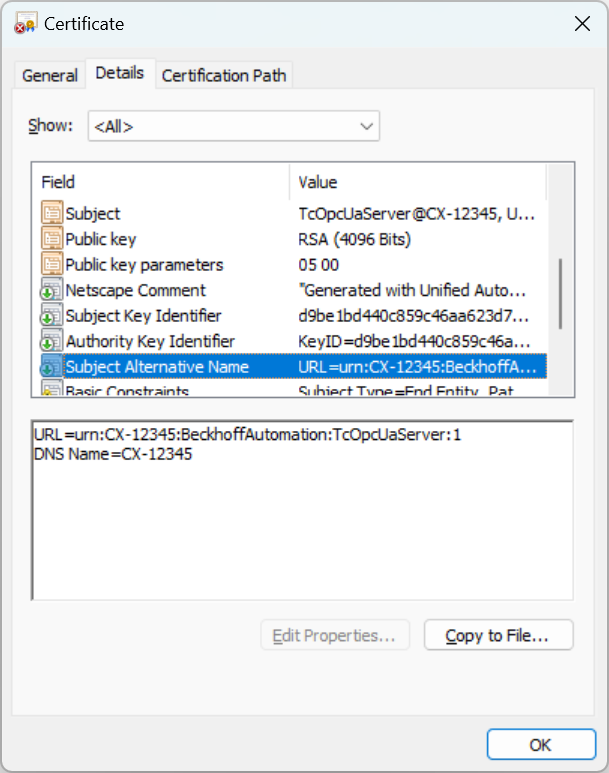
urn:CX-12345:BeckhoffAutomation:TcOpcUaServer:1
The ApplicationURI is added to the SubjectAlternativeName of an OPC UA application certificate, for example:
Setting ApplicationURI for TwinCAT OPC UA Client
When configuring the TwinCAT OPC UA Client, its ApplicationURI can be set on the configuration pages of the client I/O device.
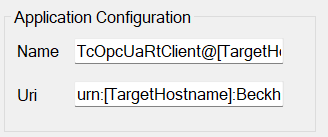
We recommend to use the default settings for the ApplicationURI but if a special use cases requires you to change it, you can do so on this configuration page. After the setting has been changed and the configuration is activated, the driver will determine if an existing application certificate that matches the ApplicationURI can be found on the target device. If a matching application certificate is found, it will be used. If no matching application certificate is found, the driver will create a new (self-signed) application certificate and uses that certificate for communication with the server. This also means that you can use different application certificates for multiple TwinCAT OPC UA Client I/O devices in your project. The default configuration is that one application certificate is used for all devices.