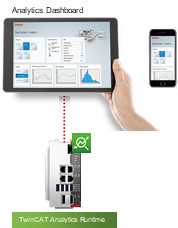
Technical introduction
With regard to the TwinCAT Analytics workflow, the Analytics Runtime is capable of performing continuous analysis of data for the local application (via ADS) or from various remote controllers. Then, the analysis runs in parallel with the machine or building applications. The Analytics Runtime is based on a standard TwinCAT PLC Runtime. The application code can be generated automatically by the Analytics Workbench. This means that users do not need to invest additional engineering resources in data analysis. The generated code is transparent and can be freely edited. Other standard PLC libraries from Beckhoff, such as Tc3_Database or Tc3_ConditionMonitoring, can also be used.
Versions
There are two versions of Analytics Runtime. The TF3550 includes an HMI, while the TF3551 does not.
TF3550 Analytics Runtime contains the following products:
- TC1200 TwinCAT 3 PLC
- TF3300 TwinCAT 3 Scope Server
- TF3510 TwinCAT 3 Analytics Library
- TF6701 TwinCAT 3 IoT Communication (MQTT)
- TF6760 TwinCAT 3 HTTPs/REST
- TF2000 TwinCAT 3 HMI Server
- TF2020 TwinCAT 3 HMI Client Pack 3
- TF2300 TwinCAT 3 HMI Scope
TF3551 Analytics Runtime Base contains the following products:
- TC1200 TwinCAT 3 PLC
- TF3300 TwinCAT 3 Scope Server
- TF3510 TwinCAT 3 Analytics Library
- TF6701 TwinCAT 3 IoT Communication (MQTT)
- TF6760 TwinCAT 3 HTTPs/REST
Possible uses
An Analytics Runtime can evaluate data via ADS (automation partially restricted) from local control applications. This can be fully integrated or in a second runtime alongside the actual one.
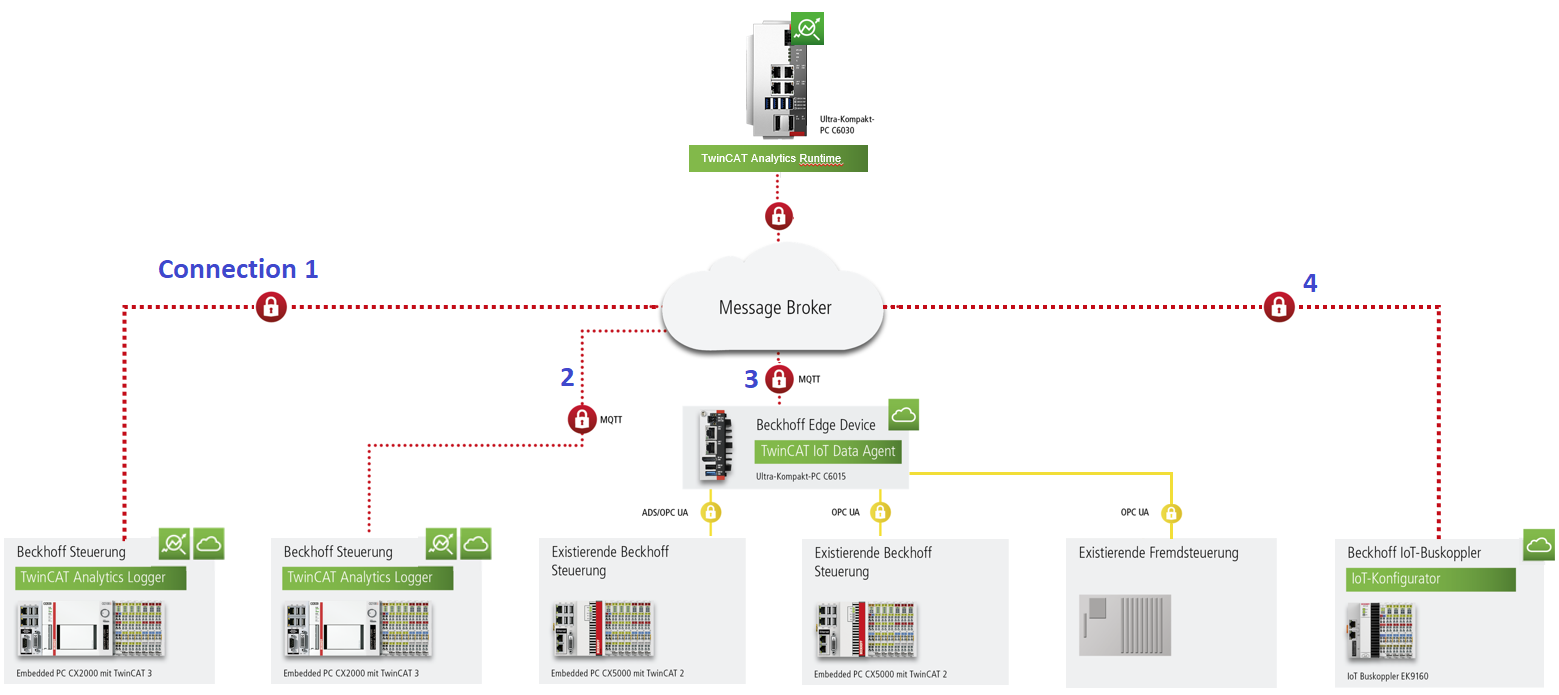
Remote systems can also be evaluated. To use all the automatic functions, communication is implemented here via MQTT (the local application can also be evaluated locally via MQTT - there are no technological restrictions). Input via MQTT is currently provided by:
- Controller with TF3500 Analytics Logger
- Controller with TF6720 IoT Data Agent (can have many subordinate controllers)
- EK9160 IoT Bus Coupler
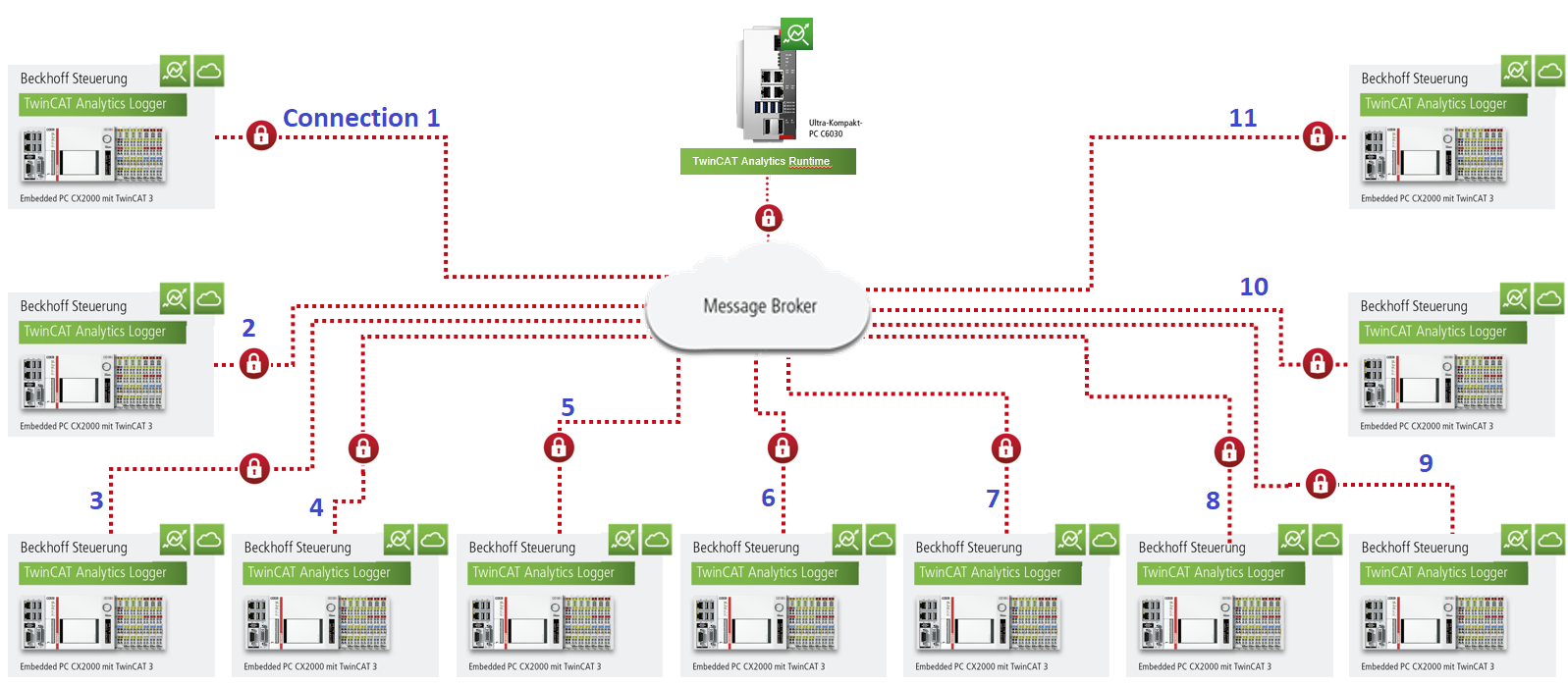
The picture below shows an application architecture with 11 connected controllers.
With the licenses of the TF3550 and TF3551, the Analytics APIs (Analytics Data Exchange API) can be used to convert data from the Analytics Eco-System to any other system. Further information can be found in the TE3500 Analytics Workbench documentation in the API chapter.
TwinCAT HMI
The Analytics Workbench can be used to automatically generate Analytics PLC code and create an Analytics Dashboard based on TwinCAT HMI. The Analytics Runtime includes the TwinCAT HMI Server (TF2000), an HMI Client Pack 3 (TF2020) and the HMI Scope (TF2300). This allows the HMI server to deliver HTML5 web pages to at least four clients simultaneously.