Project properties
Following the selection of the HMI project node, the properties of the HMI project are displayed in the Properties window.
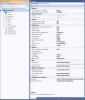
Explanations:
- Binding
- Symbol Read Error Handling: Specifies how the system responds when an error occurs during a read access to a symbol.
- Reset: The control attribute is reset to the default value.
- Ignore: The error is ignored, the control retains its current value.
- Symbol Write Error Handling: Determines how the system behaves if there is an error when writing to a symbol.
- ReadBack: The value is read out again and written to the control attribute.
- Ignore: The error is ignored, the control retains the value that could not be written.
- Build information:
- Creation: Date and time when the setup of the TwinCAT HMI was created.
- Product Version: Version no. of the TwinCAT HMI.
- Creator:
- Default Viewport Height: Default value for the height of a Viewport when a new HMI page is added. Various resolutions of the HMI can be simulated via the Viewport.
- Default Viewport Width: Default value for the width of a Viewport when a new HMI page is added. Various resolutions of the HMI can be simulated via the Viewport.
- Deployment:
- Disable Optional System Subscriptions: Deactivates system subscriptions from the TwinCAT HMI framework. These are required if bindings are created dynamically at runtime or controls are generated. Otherwise they can be disabled. This is recommended on smaller control systems to optimize performance.
- Interval [ms]: Global update rate [ms] for refreshing the HMI server symbols. This can be overwritten at symbol level for individual symbols. Default: 500 ms.
- Post Processing: Converts the files to UTF-8 without BOM during the publish process (default).
- Show Version on Splash Screen: Specifies which version is displayed on the splash screen (loading screen).
- Framework: Version number of the framework.
- Project: Version number of the project (configurable in the project properties)
- None: No version number is displayed.
- Subscription Mode: Update mode between server and client.
- Change: The server only sends the current value of the symbol if a value change has been detected. Most efficient for symbols that rarely change. Reduces network traffic.
- Poll: The server sends the current value of the symbol with each interval timer tick, regardless of whether the value has changed. Useful if current values are required at a guaranteed frequency. Generates more network traffic.
- ClientPoll: The server subscription runs in change mode. In addition, the framework executes a client-side timer (with the interval time of the subscription) and delivers the last known server value to all subscription callbacks again with each tick. Useful to guarantee periodic value updates without additional server load.
- ClientWriteConfirm (default): The server subscription runs in change mode. In addition, the framework starts a one-off client-side timer (with the interval time of the subscription) after each write operation on the symbol. When the timer triggers, the last known server value is delivered again to all listeners. This ensures that, for example, a successful write action against the server that was reset by the PLC within the interval time can be recognized, as the last valid subscription value that is redistributed in this case does not correspond to the value that was written.
- The timer is reset if another write operation takes place while the timer is already running. This prevents the interface from briefly reverting to the previous value if the server's change detection has not yet recorded the new value caused by the write operation. This is the default setting.
- Theme Name: Name of the active theme (in engineering and of the initially active theme in the client).
- Timeout [ms]: WebSocket timeout for communication between server and client for symbol access and subscriptions. Default: 20,000 ms.
- Timeout [ms] (System): WebSocket timeout for communication between server and client for system subscriptions of the framework. Default: 60,000 ms.
- Title: Title of the HMI, which is displayed in the browser (tab).
- Verbose Level:
- 0 = no messages
- 1 = error messages only
- 2 = error messages and warnings
- 3 = error messages, warnings and info
- 4 = error messages, warnings, info and debug messages
- Version: Version number of this project.
- General:
- Auto Complete for all symbols:
- Company Name: Optional name of the enterprise providing or using the HMI.
- Company’s Website: URL of the enterprise providing or using the HMI.
- Login Page: Login page of the HMI, which is displayed when authentication is active.
- Scale Mode: Scaling mode of the HMI. This setting only applies if the Viewport is configured with absolute values (pixel specifications).
- ScaleToFit: The width or height of the HMI is scaled to the current size of the browser window without a scrollbar appearing.
- ScaleToWidth: The height is scaled accordingly to the width (while maintaining the aspect ratio with scrollbar).
- ScaleToHeight: The width is scaled accordingly to the height (while maintaining the aspect ratio with scrollbar).
- ScaleToFill: The height and width are stretched to the maximum width and height of the browser window (the aspect ratio is not maintained).
- Startup View: The start page (View) of the HMI, which is loaded when opening the HMI in the browser.
- Misc:
- Project File: The name of the project file.
- Project Folder: Absolute storage location of the project.
- System Popups: Default provider (control) for system popups.
- Region and Language:
- Default Language: Default language that is loaded for the HMI project. This setting can be overwritten by the settings per user or switched in the client.
- Localization fallback: Default language from which the translation is displayed if no translation is available for the currently selected language.
- Time Format Locale: Time format of the currently set time zone that is loaded for the HMI project. This setting can be overwritten by the setting per user.
- Time Zone: Time zone that is loaded for the HMI project. This setting can be overwritten by the setting per user.
- Viewport (meta attribute)
- Scaling: Meta attributes that define the scaling behavior and adaptability of the HMI viewport in the Designer.
- Width and Height: Default settings for the size of the viewport in the Designer.