Function and structure
A current transformer is a transformer that converts an input current into a processable current signal at the output. Current transformers are mainly used to transform high currents to directly measurable smaller values in the milliamp or lower amp range. In a classic current transformer, the input current is proportional to the output current. Due to the physical operating principle and the mechanical structure, the current signal is electrically isolated for transmission to the evaluation electronics.
A current transformer basically consists of a small number of windings on the primary side and a larger number of windings on the secondary side. The current being converted flows through the primary side. The windings are usually wound on an alternating magnetic ferrite ring core.
The toroidal or ring-type CT is a typical type of transformer. Here, the busbar or current-carrying line is often used as the primary winding which is fed through the ring core of the transformer. Thus, the rail or line constitutes the primary winding with one turn. The secondary winding is located on the ring core. The transformation is determined by the primary to secondary winding ratio. The classic ring-type CT design is shown in the figure on the left below.
Another classic type is the coil current transformer. In this type of transformer, the primary winding is a current-carrying wire that is wound around the primary side of the ring core. The number of primary windings is > 1, but is smaller than the number of secondary windings. This principle is illustrated in the figure on the right below.
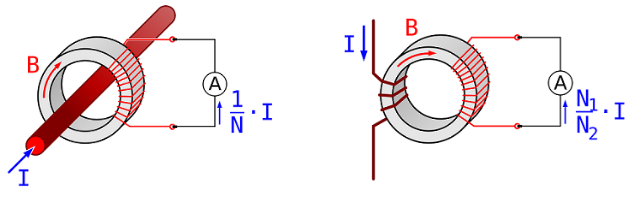 Fig.2: Left: Principle of a ring-type CT; Right: Principle of a coil current transformer
| |
Dangerous voltages if the secondary side is not connected The secondary winding must be connected to an ammeter or short-circuited, otherwise high core losses or dangerous voltages may occur on the secondary side.
|

 | Grounding of secondary terminals According to DIN VDE 0141 (01/2000) paragraph 5.3.4, current and voltage transformers for rated voltages from Um = 3.6 kV must be grounded on the secondary side. For low voltages (Um ≤ 1.2 kV), grounding is not required if the transformer housings do not have any metal surfaces with large contact areas. |
Small signal transformers with secondary signal voltage
In small signal transformers, the transformed secondary current of the current transformer is converted into a voltage signal via a low measuring resistance RM. The input impedance RV of the connected voltage electronics must be high-resistance and thus ensures a negligible influence on the measuring accuracy.
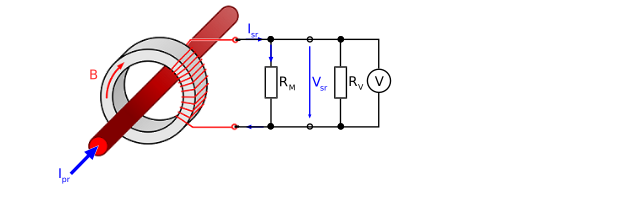 Fig.3: Principle of a ring-type CT with secondary voltage signal
The low measuring resistance prevents dangerous open-circuit voltages, eliminating the need to short-circuit the secondary connections.