Output circuit breakers
Standard miniature circuit breakers (MCBs) are commonly used for AC supply systems but can also be used in DC branches if specified.
Such MCBs are designed to protect wires and circuits. If the ampere value and the characteristics of the MCB are adapted to the wire size that is used, the wiring is considered as thermally safe regardless of whether the MCB opens or not.
To avoid voltage sags and undervoltage situations in adjacent DC branches fed by the same source, fast (magnetic) tripping of the MCB is desirable. For example, a fast trip within 10 ms avoids a shutdown and restart of the PLC. For this purpose, power supplies with high current reserves and large output capacitors are advantageous. Furthermore, the impedance of the faulty branch must be sufficiently small in order for the current to actually flow.
The following table provides typical test results showing which MCBs magnetically trip as a function of wire size and length. The lengths given correspond to the total length, which is the sum of the outgoing (+) and return (-) wire. The tests were performed without additional load.
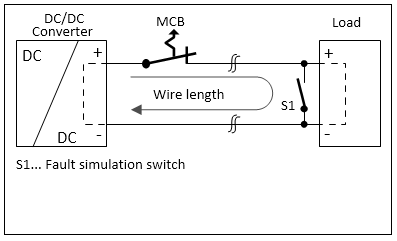 Fig.18: Test circuit for maximum wire length
Test results for maximum wire length:
| 0.75 mm2 | 1.0 mm2 | 1.5 mm2 | 2.5 mm2 |
|---|---|---|---|---|
C-2A | 23 m | 32 m | 43 m | 62 m |
C-3A | 14 m | 18 m | 26 m | 39 m |
C-4A | 8 m | 9 m | 14 m | 18 m |
C-6A | 2 m | 2 m | 4 m | 6 m |
C-8A | 0 m | 1 m | 1 m | 1 m |
| 0.75 mm2 | 1.0 mm2 | 1.5 mm2 | 2.5 mm2 |
|---|---|---|---|---|
B-6A | 11 m | 13 m | 21 m | 29 m |
B-10A | 2 m | 2 m | 4 m | 4 m |
B-13A | 1 m | 1 m | 1 m | 2 m |