Measuring principle
The KL3403 works with 6 analog/digital converters for recording the current and voltage values of all 3 phases. The values are sampled with a time grid of approximately 16 µs.
Recording and processing is synchronous and identical for the 3 phases. The signal processing for one phase is described below. This description applies correspondingly for all 3 phases. The total power and the total energy consumption represent the sum of the 3 phases, the mean current represents the average.
Voltage u and current i curves
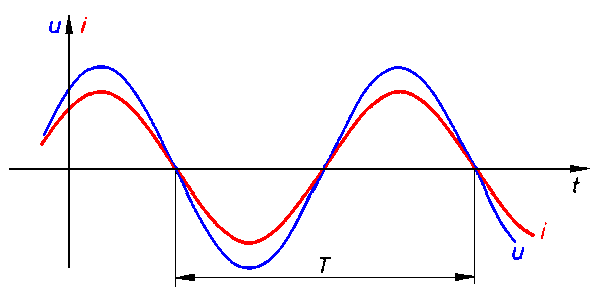 Fig.3: Voltage u and current i curves
RMS value calculation
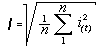
The rms value for voltage and current is calculated over a measuring interval, in this case the period T. The following equations are used:
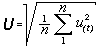
u(t): instantaneous voltage value
i(t): instantaneous current value
n: number of measured values
For a measurement in a 50 Hz mains system (period T = 20 ms), 1280 measured values are considered within a calculation.
Measuring interval
The choice of the right measuring interval is important for the quality of the measurement. The measuring interval must be at least ¼ T. ¼ T, ½ T, T end multiples of ½ T are sensible values. If a random interval is used that does not correspond to a multiple of ½ T and is significantly less than 5 T, the measured value will fluctuate significantly.
The default setting for the measuring interval is 50 ms, corresponding to 2.5 T in a 50 Hz mains system and 3 T in a 60 Hz mains system. Experience shows that this is a good compromise between measuring speed and stability. Deviations from this value are only advisable in the event of particular measurement requirements (e.g. high measuring speed, low signal frequencies or special current curves).