4‑wire vs. 6‑wire connection
With a constant voltage supply, the magnitude of the current can be quite considerable, e.g. 12 V / 350 Ω ≈ 34.3 mA. This leads not only to dissipated heat, wherein the specification of the strain gauge employed must not be exceeded, but possibly also to measuring errors in the case of inadequate wiring due to line losses not being taken into account or compensated.
In principle a full bridge can be operated with a 4‑conductor connection (two conductors for the supply UExc and two for the measurement of the bridge voltage UBridge).
If, for example, a 25 m copper cable (feed + return = 50 m) with a cross section q of 0.25 mm2 is used from the sensor up to the evaluating measurement module, this results in a line resistance of
RL = l/ (κ · q) = 50 m / (58 S · m/mm2 · 0.25 mm2 ) = 3.5 Ω
If this value remains constant, then the error resulting from it can be calibrated out. However, assuming a realistic temperature change of, for example, 30° the line resistance RL changes by
ΔRL = 30 K · 3.9 · 10‑3 1/K · 3.5 Ω = 0.41 Ω.
In relation to a measuring bridge with 350 Ω input impedance this means a measuring error of > 0.1 %.
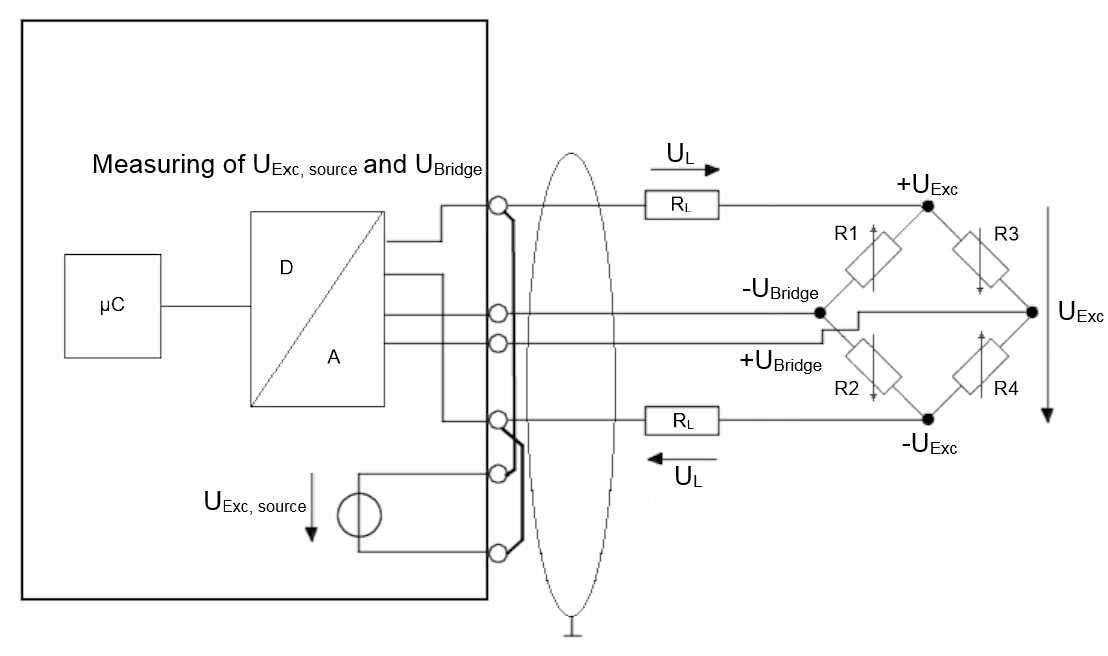
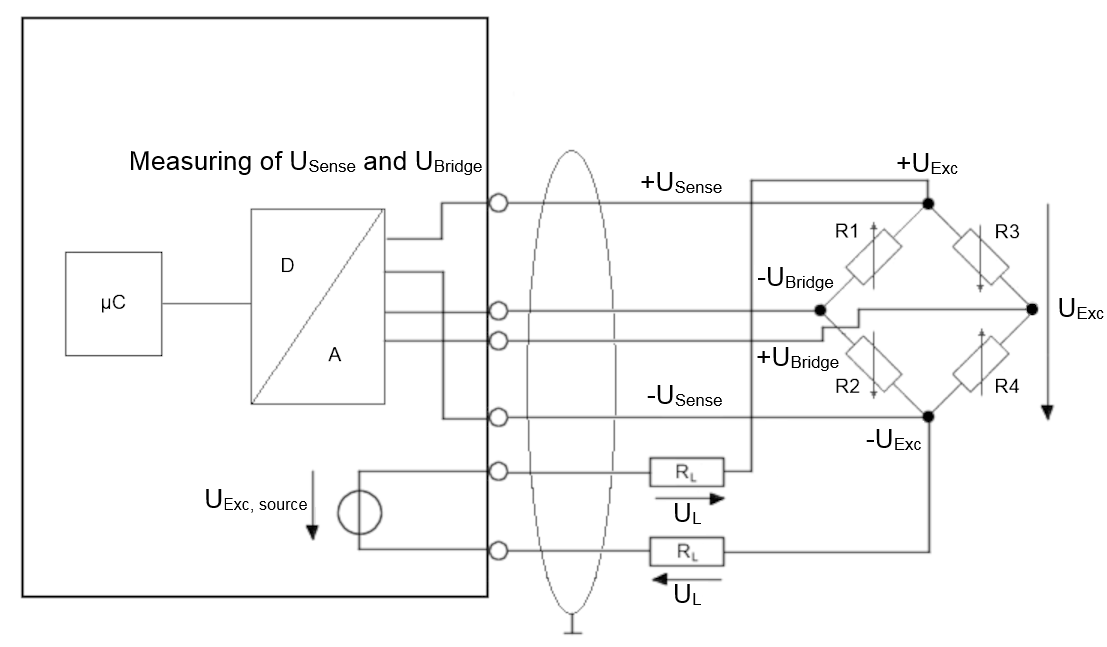
This can be remedied by a 6‑wire connection, in particular for precision applications.
The supply voltage UExc is thereby fed to the bridge (results in the pair of the current‑carrying conductors, the feed line). The supply voltage UExc is only measured with high impedance as reference voltage USense as the bridge voltage UBridge with two almost currentless return conductors each directly at the measuring bridge in the same way (often described as "Sense" input on measurement devices). Some measuring amplifiers then automatically increase the supply voltage thus far that the desired supply voltage is available at the bridge despite the potential difference on the supply line. In any case, the conductor‑related errors can be compensated by the back measurement of USense.
Since these are very small voltage levels of the order of mV and µV, all conductors should be screened.