Common-mode behavior in unbalanced full bridges
In a full bridge, the bridge voltage and the actual supply voltage are measured differentially:
UBridge = U(+UBridge) - U(-UBridge)
USense = U(+USense) - U(-USense)
The ratiometric measurement is calculated as UBridge / USense. The common-mode voltage UCM of the bridge outputs relative to AGND is:
UCM = USense / 2
In a symmetrical bridge configuration, UCM is approximately half the supply voltage UExc.
A resistor RSpan connected on one side (see figure “Full bridge with single-sided span compensation”) for span or temperature compensation, or, more generally, unequal (cable) resistances between the power supply and the resistor bridge, shift the common-mode voltage UCM (relative to -AGND), without affecting the actual differential bridge function.
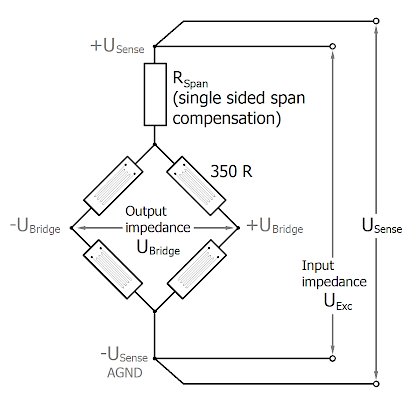
Beckhoff measuring devices with bridge measurement functionality (e.g., terminals from the ELM3xxx series) measure both UBridge and USense differentially and evaluate both voltages ratiometrically. When the sensor is powered and the bridge is loaded as intended, the output potentials UBridge of a passive bridge typically lie between AGND and +Uv. An internal shift in UCM within the sensor therefore does not result in any additional limitations during normal bridge operation, provided that the product-specific permissible input potentials relative to AGND are observed, particularly with external or potential-free power supply.
Since the common-mode rejection of a real measurement amplifier is limited and ex factory calibration is typically performed using a symmetrical bridge at UCM ≈ 1/2 UExc, a different common-mode voltage can cause a small static offset in the measured value. This is compensated for by the recommended tare adjustment of the fully assembled measurement system. However, tare adjustment does not eliminate the need to comply with the permissible input voltages, nor does it compensate for any subsequent changes in the common-mode voltage.