Timestamp inputs (EPP6224-0522)
Timestamp inputs are digital inputs that detect signal edges with very high-resolution timing.
In contrast to digital inputs without a timestamp function, timestamp inputs are event-driven: When a signal edge is detected, the current timestamp is saved in the device. The saved timestamp is transferred to the controller with the cyclic process data in the following EtherCAT cycle.
The timestamp is obtained from the EtherCAT distributed clocks (DC). This means that the timestamps are comparable with the timestamps of other DC-capable EtherCAT devices across the network (deviations typically well below 1 µs, depending on the topology).
The resolution of the distributed clocks and therefore the timestamps is 1 ns.
Possibilities and limits
- Only one rising and one falling signal edge is saved per EtherCAT cycle. You can set whether the timestamp of the first or last signal edge should be saved for several signal edges per EtherCAT cycle.
- The high input sensitivity makes the inputs susceptible to interference from effects such as.
- Bouncing
- EMC
This may lead to increased demands on the cabling and the signal transducer (sensor, switch, ...).
Example
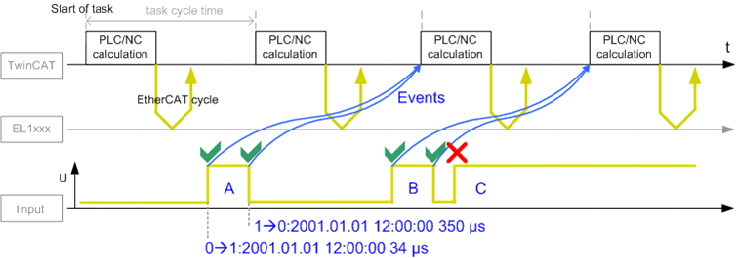
In this figure, the rising and falling edges of pulse A are each recorded as events with a timestamp and transferred to the controller in the subsequent EtherCAT cycle. The temporal resolution is 1 ns here – an ‘infinitely’ fine time resolution in mechanical terms. The device only saves one falling and one rising edge per cycle. If several edge changes occur, such as the rising edge of pulse C, the first or last event is saved, depending on the configuration.