Fiber-optic cables
The EP9521-0020 is intended for combination with multimode optical fiber cables with the following properties:
- LC Duplex plug or, in the IP67 version, PushPull LC Duplex Multimode plug (SFP version) made by HARTING
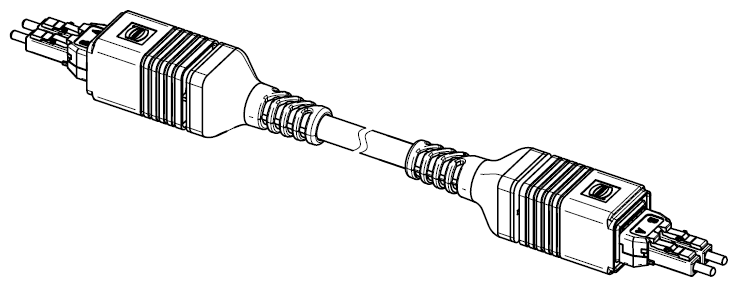
- Multimode cable 50/125 µm
 | Recommended connectors The PushPull LC DUPLEX plug by HARTING is compulsory for IP67 use of the box. The mechanical construction guarantees the leak-tightness and suitable height offset of the fiber-optic plugs inside the protective housing. The plug is available from Beckhoff as a set of 10 under the order designation ZS1091-0001. Processing requires experience in the assembly of optical fiber cables! |
In optical fibers the wavelengths 850 nm and 1300 nm are usually used for data transfer. The optical fiber cables available on the market are mostly optimized for use in one of these ranges, since the attenuation of the signal (as with copper cables) is frequency-dependent – long ranges of several km can then be achieved with the respective wavelength. In general, optical fiber cables in the 1300 nm window exhibit a lesser attenuation than in the 850 nm window.
In the EP9521-0020 a transceiver with the wavelength of 1300 nm is used.
| Range and bandwidth product Optical fiber cables are available in different qualities from reputable manufacturers. One of the relevant parameters for the user is the frequency-dependent bandwidth product of a cable, specified in [MHz × km]. The greater the bandwidth product, the lower the attenuation, and therefore the larger the range that can be achieved with this cable (see ITU-T G-651). For achieving the maximum range, optical fiber cables with a maximum bandwidth product of 1300 nm should therefore be used; we recommend using class OM2 optical fiber cables (EN50173:2002). |
| Routing notes The following parameters must be taken into account in the installation of optical fiber cables
|
Further information can be found in the following documents:
- ITU recommendation ITU-T G.651 - G.655
- EN 50173:2002
- EN 60793-2
Connecting the optical fiber cable to the box
Notice | |
Do not pull on the optical fiber cable! So as not to damage the optical fiber cable, never pull the cable when disassembling, always pull the plug which releases the catch! |
| Use of crossed optical fiber cables Please note that when connecting two EP9521-0020 modules together, crossed cables must be used in order to establish a connection. |
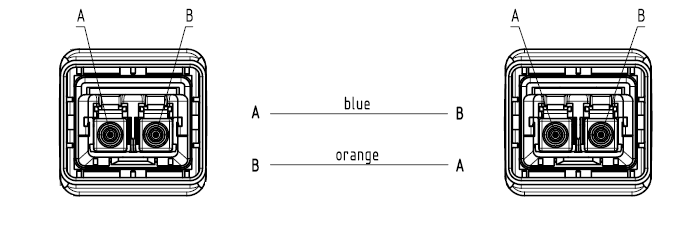 Fig.11: Crossed optical fiber connection
 | Use of blind plugs To protect the transceiver from environmental influences, unused connection socket should be sealed with the blind plugs provided! |