BiSS® C, unidirectional
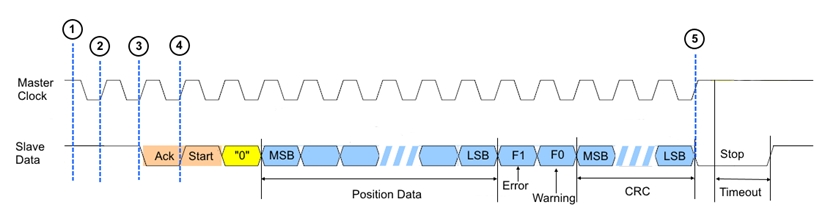
The transmission of the data is triggered by the master clock. The end of the data transmission is marked with a timeout. A typical communication telegram is shown below:
- Idle state: the master clock displays a HIGH value and the BiSS® C slave also displays its "Ready State" with a HIGH value.
- Synchronized position detection is started with the first rising edge of the master clock.
- After the 2nd rising edge of the master clock, the slave responds with a LOW level ("Ack" interval).
- After the "Ack" interval has ended, the slave generates a "Start" bit, which is always followed by a "0" bit.
The position data is transmitted with the 2nd bit after the "Start" bit, according to the data format of the slave. Communication is synchronized with the master clock.
The status bits "Error" and "Warning" as well as the checksum (CRC) are transmitted after the position data. - The telegram ends with the BiSS® timeout. No further pulses are sent to the slave, the master clock switches to the idle state (HIGH level).
After the timeout has expired, the slave is ready to transmit new position data once it has transitioned to idle status (HIGH level). The communication telegram starts again.
Example of a BiSS® C telegram