Dithering
Dithering reduces the influence of static friction when controlling an actuator. The actuator is constantly moved back and forth with a small amplitude so that no static friction occurs even when stationary. This prevents jerking during the transition from static friction to sliding friction.
The continuous movement of the actuator is achieved by a square wave signal that is modulated onto the PWM signal.
Configuration
You can enable and configure dithering with the following parameters:
Index 1) | Name | Description |
|---|---|---|
0x8pp0:03 | Enable Dithering | Enables dithering |
0x8pp0:1E | Dithering frequency | Frequency of the square wave signal in Hz |
0x8pp0:1F | Dithering amplitude | Amplitude of the square wave signal. Specified as a percentage of the maximum output current configured via "Max Current". (See chapter Basic configuration)
|
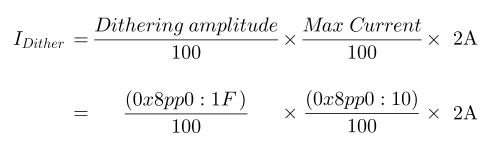
1) pp = 00…03 for channel 1…4
For dithering to work, the current must be able to follow the square wave signal sufficiently. This is achieved by a suitable combination of dithering parameters and current controller parameters. See also Chapter Current controller optimization.
Example
Poor configuration | Good configuration |
|
|
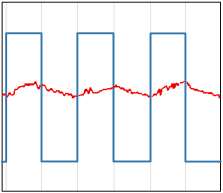
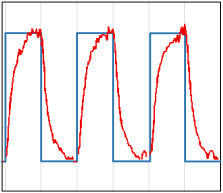
Dithering frequency: 100 Hz
Dithering amplitude: 10 %
Horizontal scaling: 5 ms/div
Blue: current setpoint
Red: actual current value
The figures show a dither of 10 % of the rated current at 100 Hz.
The controller therefore has a time of 5 ms to compensate for a current pulse of 10 %. The steepness of the current rise is limited by the controller parameters and the inductance of the load.