Diagnostics
Errors and warnings are reported channel by channel in the process data via the status bits "Warning" and "Error". Example for channel 1:
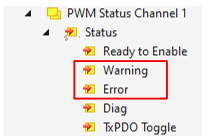
Difference between warnings / errors
- Warnings are purely informative. The box continues to function without restriction.
- Errors lead to shutdown of the affected output. To re-enable the output, you must acknowledge the error via the bit "Reset".
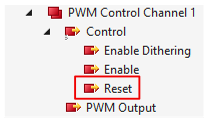
Narrow down the cause of the error
If a warning or error is reported on a channel, you can narrow down the cause using the CoE object 0xApp0 "PWM Diag Data Ch.n" of the respective channel.
(0xA000 for channel 1, 0xA010 for channel 2, etc.)
The following table shows the meaning of different combinations of status bits and CoE parameters.
|
|
|
|---|---|---|
0xApp0:02 "Overtemperature" | Internal temperature above 75 °C. | Internal temperature above 85 °C. |
0xApp0:04 "Undervoltage" | Supply voltage UP below 20.4 VDC. | Supply voltage UP below 12 VDC. |
0xApp0:05 "Overvoltage" | Supply voltage UP above 28.8 VDC. | Supply voltage UP above 30 VDC. |
0xApp0:06 "Short Circuit" | -- | The output current was at least 2.5 A for more than 660 µs. |

(pp = 00…03 for channel 1…4)
 | "Overtemperature", "Undervoltage" and "Overvoltage" are not channel-specific and are always reported for all channels simultaneously. |
Examples:
- If the bit "Warning" of channel 1 has the value 1 and the CoE parameter 0xA000:04 "Undervoltage" is set to TRUE, the supply voltage UP is currently below the threshold value of 20.4 V.
- If the bit "Error" of channel 3 has the value 1 and the CoE parameter 0xA020:06 "Short Circuit" is TRUE, the cause of the error is an overcurrent or short circuit on channel 3.