Limiter
The limiter allows the electrical output value to be limited in order to protect the connected signal sink.
Parameters:
Index (hex) | Name |
|---|---|
80nD:1C | Limiter Low Value |
80nD:1D | Limiter High Value |
Result:
A setpoint higher/lower than the limit values leads
- to an increase of +1 in the corresponding counter index 0x90n0:06 “Limiter Low Counter” or index 0x90n0:07 “Limiter High Counter” (stored secured against power failure)
- to the display Error + Overrange/Underrange in the PDO “AO Status and Error LED”
- to a limitation of the electrical output in the amount of the set amplitude
By default, the limiter is set to the maximum limits of the technical OFSV and therefore has no effect.
The counter is reset
- by the command x402n to index 0xFB00:01 (channel 1: n = 0, channel 2: n = 1, ...), a successful reset is shown by “255” in index 0xFB00:03 “Response”.
- or by the command x4001 “Reset all AO counters”
- or by changing the interface
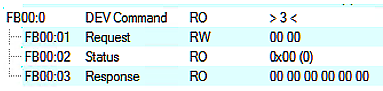
During command execution, “Status” 255 “busy” is displayed in index 0xFB00:02, “0” means “successfully completed”.
The firmware responds to an unknown command with

The limiter limits can be password protected, see section “Password protection for user data”.
Example: Sawtooth 1…7 V is output and then a “Limiter High Value” of 5 V is set:

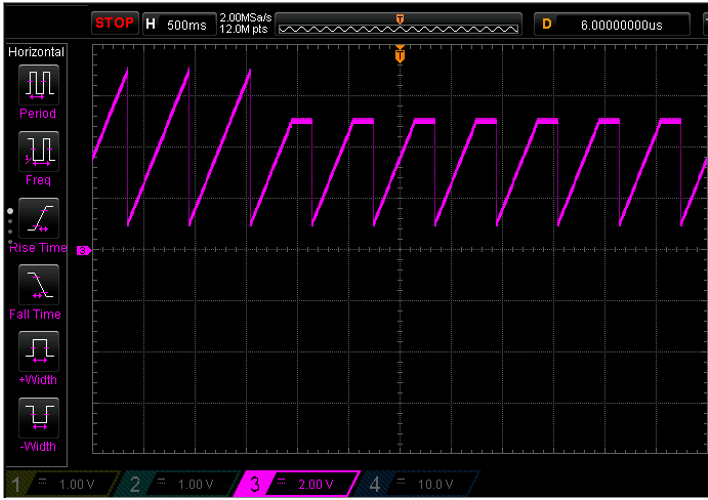
The overrange is counted accordingly below:

Note:
| |
Consider additional protective functions! The limiter function protects the connected load from unintentionally high or low outputs, for example due to programming errors. However, it is possible that malfunctions may occur. Depending on the expected level of damage, additional protective functions should therefore be provided. The function may not be used for functional safety purposes! |
