General information on commissioning the EL407x
- The EL407x terminals EL4072, EL4074, EL4078 are functionally identical except for the number of channels; the EL4072 is used as an example below.
- The output channels are set by default to Interface ±10 V, Floating Point, Extended Range.
- Temporal operating behavior of the EL407x
The terminals support the following EtherCAT operation modes - FreeRun: no
- SM-synchron (frame triggered): yes
- DistributedClocks: no
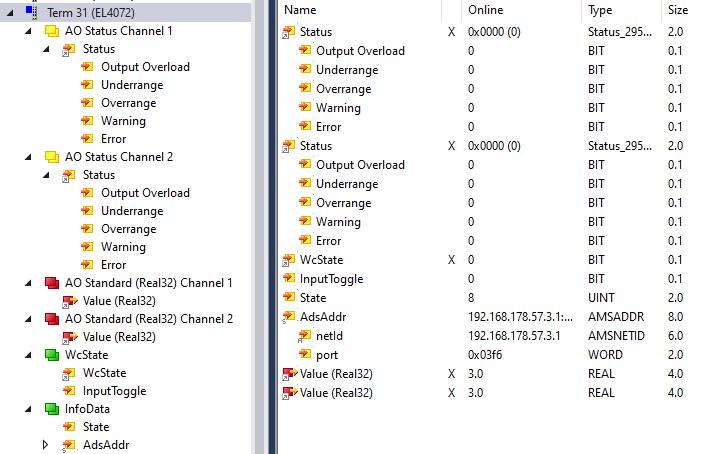 Fig.146: TwinCAT tree EL4072, online values as an example
The terminals support EtherCAT cycle times of up to 50 µs, but the following minimum cycle times are recommended for precise value output:
- EL4072: >= 150 µs
- EL4074: >= 250 µs
- EL4078: >= 500 µs
If these values are not reached, it cannot be guaranteed that analog value output will begin in the corresponding output cycle. This may result in delayed output in the order of several cycles. The fact that the internal analog value output can no longer follow the cycle reliably can be recognized by the incrementing of the local “SM Output” error counter CoE 0x1C32:0C.
Example EL4078:
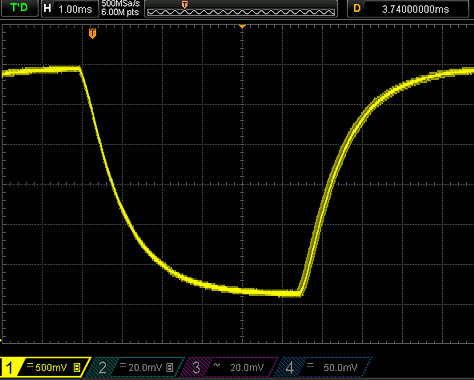 Fig.147: EL4078 with 500 µs EtherCAT cycle time, output jitter according to theory ±0.5 cycles
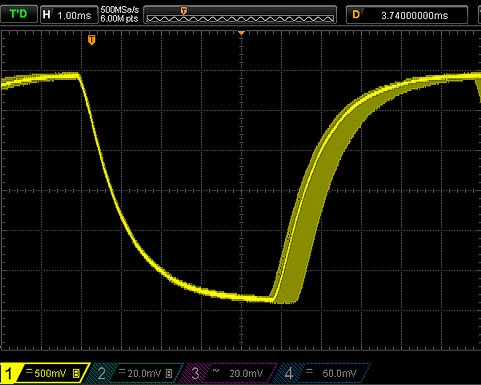 Fig.148: EL4078 with 100 µs EtherCAT cycle time, output jitter > 1 ms
If such time-precise analog value output is required, switch to the EL41xx or EL47xx series.
- The terminal contains several functions that are controlled
- by enabling/disabling cyclic process data (PDO) at commissioning time in the EtherCAT master
- by setting/changing so-called CoE settings in the device, this can be done during runtime
- The functions of this terminal are explained in the following commissioning chapter.
- for CoE parameterization:
- CoE registers are named below, the "n" in the index stands for the channel number in the terminal:
Channel 1: n=0, channel 2: n=1, ... - The CoE values cannot be read in real-time; they are updated in the online display in TwinCAT approx. every second, or can be get (or written, depending on the type) from the controller via ADS with an update rate of up to a few ms (depending on the EtherCAT cycle time).
- Before initial commissioning, it may be useful to reset the CoE parameters of the terminal using CoE reset by entering the value after 0x1011:01; this covers all channels
(see chapter "Restoring the delivery state") - "Default" or "Default setting" means that the setting named in this way is the basic setting ex factory or CoE reset.
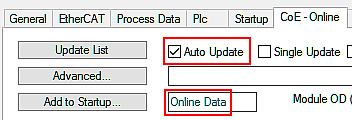 Fig.149: CoE online tab