Period value measurement
In addition to the count value, the period value (Period value) can also be calculated and displayed. The following limit values apply to the determination of measured values:
Measured value | Measured value limit | Comment | |
|---|---|---|---|
Lower | Top | ||
Period value | 0.20 µs | 21 s | With 4-fold evaluation, signal type: “RS422 (diff. input)” |
1 µs | 21 s | With 4-fold evaluation, signal type: “TTL (single ended)”, “open collector” | |
Period value measurement sequence (Period value)
- For the period value measurement, the time between two positive edges of input A is measured with a resolution of 10 ns.
- In each case the last period within the PLC cycle is considered and output as separate process data “Period value” (0x60n0:14).
- “Period scaling” (index 0x80n0:14) indicates the resolution of the output period value. The default value is 10 ns. Alternatively the period value can be output in the unit 100 ns (set 0x80n0:14 “Period scaling” to 100dec) or 500 ns (set 0x80n0:14 “Period scaling” to 500dec).
- If no full period is detected within a PLC cycle (two positive edges of input A), the last valid value is output.
- The period measurement continues across cycles. As soon as a new value is available, the process data “Period value” (0x60n0:14) is updated.
- If no full period is detected within 21 s, the measurement is discarded and the output in the process data “Period value” (0x60n0:14) is set to the maximum value 2147483648.
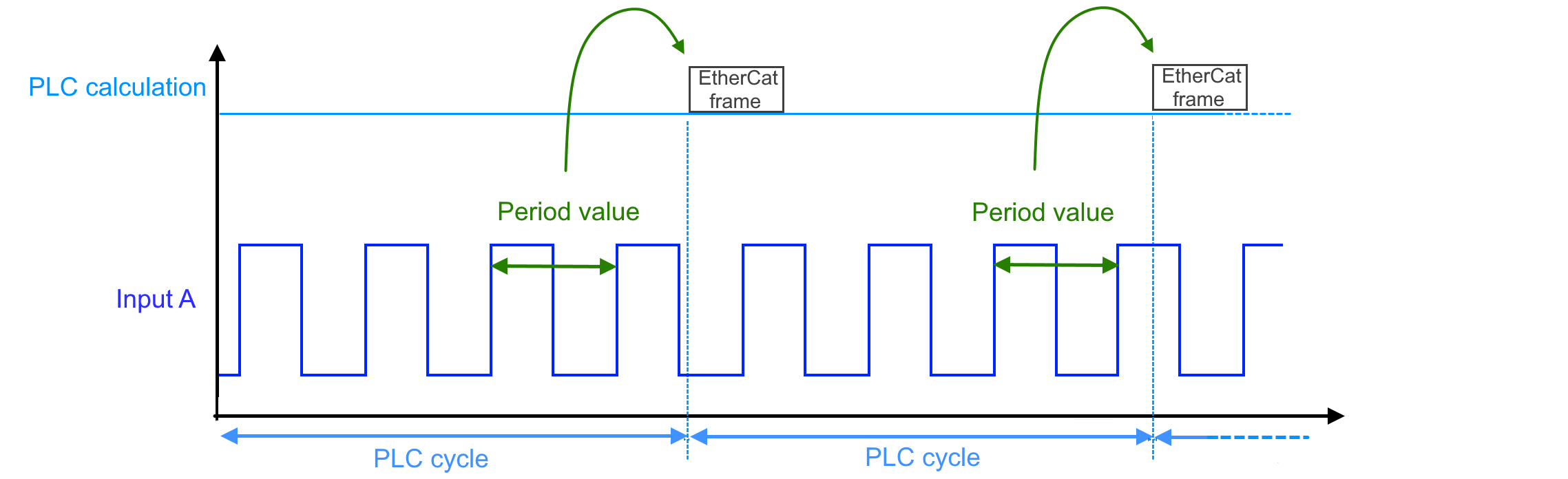
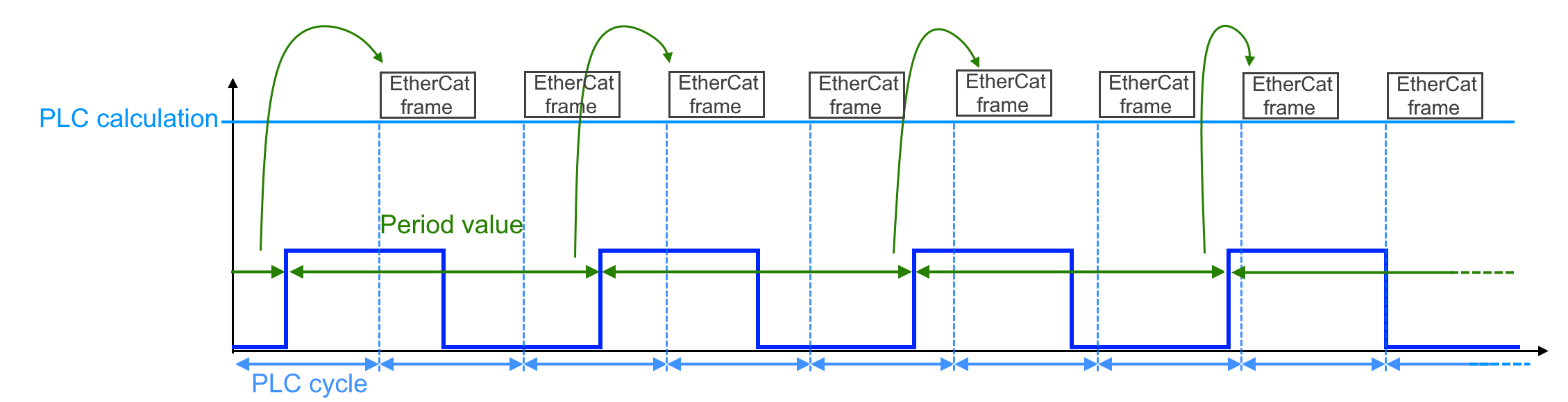
 | Difference between frequency and period value measurement The period value is recalculated for each cycle and output in the process data. The frequency measurement always averages the measured periods over a timeframe. Thus, “Period value” is a current value, and “Frequency value” is an average value. |