Determining the IP address
Connect the IPC to your network via a network cable to access the Linux® system remotely. For remote access, you need the IP address of the Linux® system. The following options are available to determine the IP address of the Linux® system in your network:
Determine IP address with monitor
There are several ways to determine the IP address to access the device via the network. If you have connected a monitor, you can log in with the username Administrator and password 1. After you have logged into the Linux® system locally, enter the following command for compact, tabular display of the IP address:
ip --brief addrIn the case of non-English keyboard layouts, the hyphen '-' may be in a different position on the keyboard.
Enter the command ip addr show in the console for a complete and detailed output of the network interfaces. This output shows each network interface with all details: name, status, MTU, MAC address, IP addresses (IPv4 & IPv6), broadcast, flags, etc.
ip addr showThe output looks as follows:
Administrator@BTN-000twtq7 ip addr show
1: lo: <LOOPBACK,UP,LOWER_UP> mtu 65536 qdisc noqueue state UNKNOWN group default qlen 1000
    link/loopback 00:00:00:00:00:00 brd 00:00:00:00:00:00
    inet 127.0.0.1/8 scope host lo
       valid_lft forever preferred_lft forever
    inet6 ::1/128 scope host noprefixroute
       valid_lft forever preferred_lft forever
2: end1: <NO-CARRIER,BROADCAST,MULTICAST,UP> mtu 1500 qdisc mq state DOWN group default qlen 1000
    link/ether 00:01:05:3d:69:12 brd ff:ff:ff:ff:ff:ff
3: end0: <BROADCAST,MULTICAST,UP,LOWER_UP> mtu 1500 qdisc mq state UP group default qlen 1000
    link/ether 00:01:05:3d:69:13 brd ff:ff:ff:ff:ff:ff
    inet 192.17.42.14/22 metric 1024 brd 192.17.43.255 scope global dynamic end0
       valid_lft 689597sec preferred_lft 689597sec
    inet6 fe80::201:5ff:fe3d:6913/64 scope link
       valid_lft forever preferred_lft forever
Administrator@BTN-000twtq7:~$
Network interfaces marked with "UP" are automatically assigned an IP address (this does not necessarily require a DHCP server to be present in the network). In this example, the network interface end0 has been assigned the IPv4 address 192.17.42.14/22 and the IPv6 address fe80::201:5ff:fe3d:6913/64.
Determine IP address without monitor
If your Windows and Linux® systems are in the same Ethernet segment, you can determine the local IPv6 address of the Linux® system as follows:
First identify the network interface of your Windows system with the command ipconfig. Search the output for the desired network connection and note the interface number labeled %??. This number is required to correctly ping the IPv6 link-local address. The output in PowerShell could look like this:
Ethernet adapter Ethernet 5:
   Connection-specific DNS Suffix .. : example.com
   Link-local IPv6 Address . . . . . : fe80::5197:ef72:a352:b7f7%17
   IPv4 Address. . . . . . . . . . . : 172.17.42.17
   Subnet Mask . . . . . . . . . . . : 255.255.252.0
   Default Gateway . . . . . . . . . : 172.17.40.1
Use the command ping ff02::1%?? to check which IPv6-enabled devices are active and accessible on the local network. %?? is the interface number (interface index), which specifies the network interface to use for sending a ping. For example, if the interface number of your network interface was 17, the command would look like this:
ping ff02::1%17If the ping is successful, you will receive a list of the responses from the various devices on the network:
Pinging ff02::1%10 with 32 bytes of data:
Reply from fe80::201:5ff:fe50:5911: icmp_seq=1 ttl=64 time<1 ms
Reply from fe80::201:5ff:fe3d:6913: icmp_seq=1 ttl=64 time<1 ms
...
Depending on your network and firewall settings, the request may time out. However, this is not a problem and you can continue with the command Get-NetNeighbor.
Use the following command in PowerShell to determine the MAC address of the target system:
Get-NetNeighbor -LinkLayerAddress 00-01-05* -AddressFamily IPv6The output lists the MAC addresses and the corresponding IPv6 addresses of all devices in the network whose MAC address starts with 00-01-05. Identify the Beckhoff RT Linux® system using the MAC address on the name plate of the industrial PC and make a note of the IPv6 address.
Use the following ping command to ensure that the target system can be reached. Replace %?? with the corresponding interface number and enter the IP address:
ping fe80::201:5ff:fe3d:6913%17You can use the IPv6 address determined to access the Linux® system via an SSH connection. To do this, use the following command:
ssh Administrator@fe80::201:5ff:fe3d:6913%17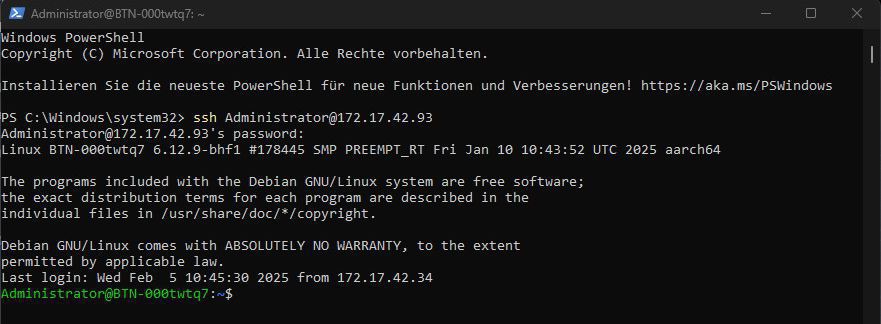
Determine IPv6 address using the MAC address
If PowerShell cannot be used, the IP address can be derived from the MAC address using the EUI-64 method instead. A typical MAC address consists of 48 bits and is represented in the form XX:XX:XX:XX:XX:XX. Example: 00:1A:2B:3C:4D:5E.
- 1. Split the 48-bit MAC address into two 24-bit halves.
- First 24-bit half:
00:1A:2B - Second 24-bit half:
3C:4D:5E
- 2. Insert the 16-bit 'FFFE' mark in the middle, placing the 16-bit sequence
FFFEbetween the two halves. This results in a 64-bit address:
00:1A:2B:FF:FE:3C:4D:5E
- 3. The universal/local bit (bit 7 from the left in the first octet) is then inverted.
- The first octet of the MAC address is 00 → binary: 00000000
- Bit 7 (from the left, index 1) is 0 → invert it to 1: 00000010
- The hex form of 00000010 is 02 → new first block: 02
- New address: 02
:1A:2B:FF:FE:3C:4D:5E
- 4. Convert to IPv6 format and add prefix: The modified 64-bit address is combined with the link-local prefix
fe80::to obtain the full IPv6 address:
- Result of the conversion:
fe80::021a:2bff:fe3c:4d5e
- 5. A ping command
ping <IPv6-Adresse>can be used to check the accessibility and connectivity of a device in the local network.